
Shop · Category
PE pipe scanners
Scanners for butt-fusion and electrofusion joints of polyethylene pipelines.
 Exclusive distributor of the DOPPLER brand
PL · LT · LV · EE
Showing all 3 results
Why polyethylene is inspected differently from steel
Polyethylene pipe is replacing steel wherever corrosion is the problem — in water mains, gas networks and process installations. The material behaves quite differently: shear waves do not propagate in it, so inspection relies on longitudinal waves alone. Velocity is low, around 2350 m/s for PE80 and 2386 m/s for PE100, and attenuation is high and strongly frequency dependent — measured at 0.5 dB/mm at 2 MHz and 1.1 dB/mm at 4 MHz (TWI work under the TestPEP project).
Then there is the joint geometry. Butt fusion leaves a weld bead on both surfaces, and it is usually left in place. The probe therefore cannot stand in the optimal position — it has to stand further back and look in at a steeper angle, which is solved with water wedges. A PE scanner is not the same device as a steel pipe scanner, however similar it looks.
Techniques and their real detection rates
Qualification work on butt fusion joints uses four complementary techniques: a sector pulse-echo scan covering most of the fusion zone, self-tandem sensitive to planar flaws nearer the inner surface, a creeping wave for the region just below the outer surface, and TOFD across the volume. On pipes of 220–710 mm outside diameter and 14–45 mm wall, with reference flaws of 1.5–8 mm, the sector technique detected 88% of flaws and self-tandem 55%; counting only flaws inside each technique's coverage, 91% and 84%.
The practical conclusion is that no single technique is enough, and that the procedure has to be qualified on samples with artificial flaws for the given diameter range and material grade. Velocity varies not only between PE80 and PE100 but between batches of pipe.
| Scanner | Joint type | Diameter range | Features |
|---|---|---|---|
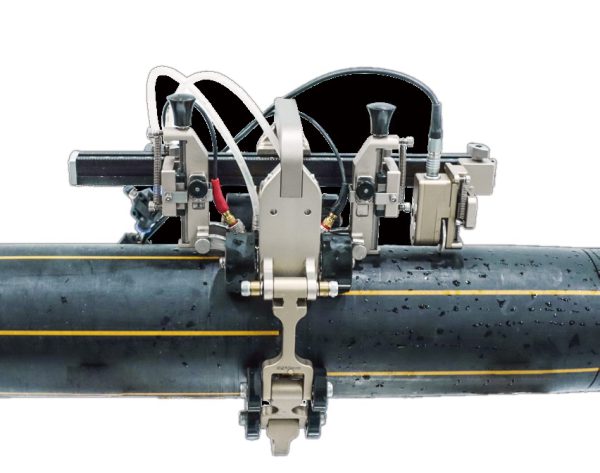
| MOS05-D | butt fusion joints | Ф60–400 mm | quick-release chain, TOFD probe holders, 120 mm radial clearance required |
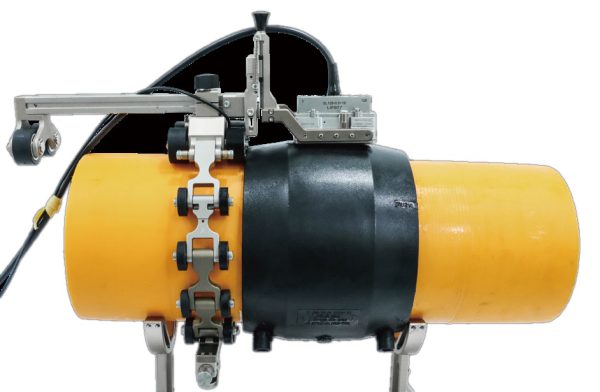
| MOS05-B | electrofusion joints | Ф90–400 mm | wedge up to 44 mm, pipelines with coaxial reducers, IP67 |
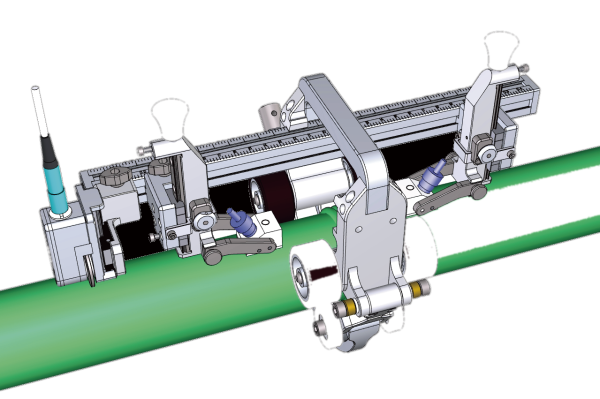
| PE Pipe Scanner with water jacket | butt fusion, small diameters | 32–90 mm to order | water jacket with a sealing ring, support wheel, encoder |
Frequently asked questions
Does the weld bead have to be removed first?
No. The techniques developed for PE assume the bead stays in place — hence the water wedges and steeper angles. You only have to keep the probe further from the joint centreline than half the bead width, which is why bead width is asked for when selecting a scanner.
Which frequency should be used?
Thinner walls suit 4 MHz probes; thicker ones call for 2 MHz, because attenuation in PE more than doubles between those frequencies. The TestPEP work used 32-element 4 MHz probes on smaller pipes and 2 MHz on larger ones.
Are reference blocks and reference samples needed?
Yes. With PE you cannot rely on a tabulated velocity — it has to be determined for the material, and sensitivity set on a sample containing flaws representing what you are looking for. We help prepare such a set and write up the technique; we also perform PE joint inspection as a service.