
Shop · Category
Electromagnetic yokes for MT
Hand-held electromagnetic yokes for magnetic particle testing: mains-powered Uniflux and battery-powered models, with AC and DC fields.
Showing all 4 results
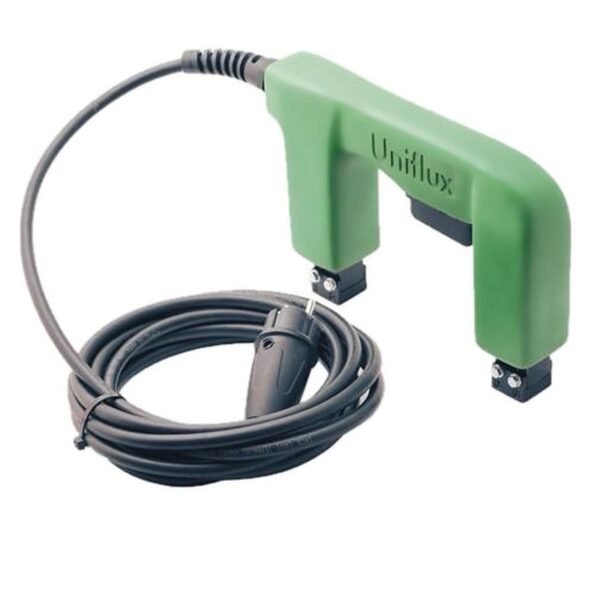
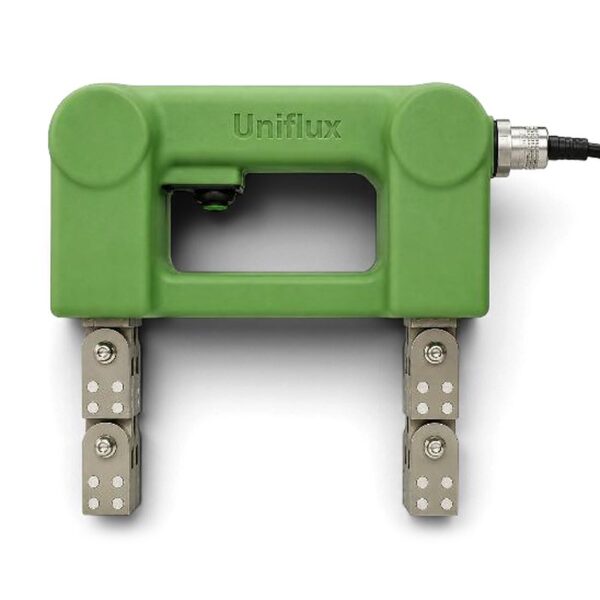
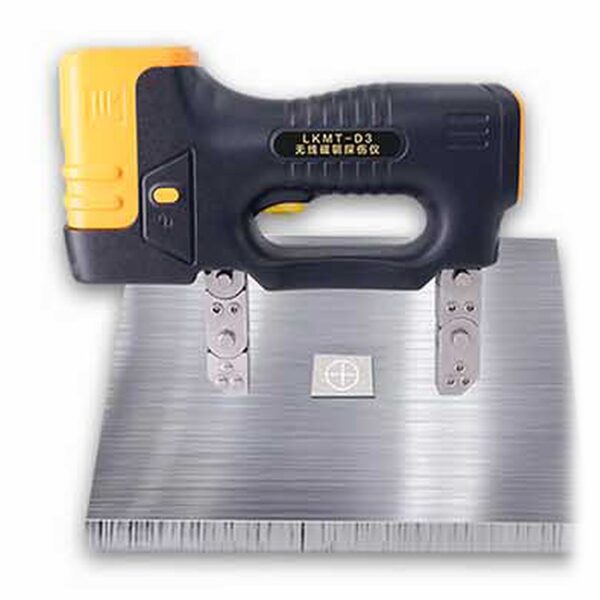
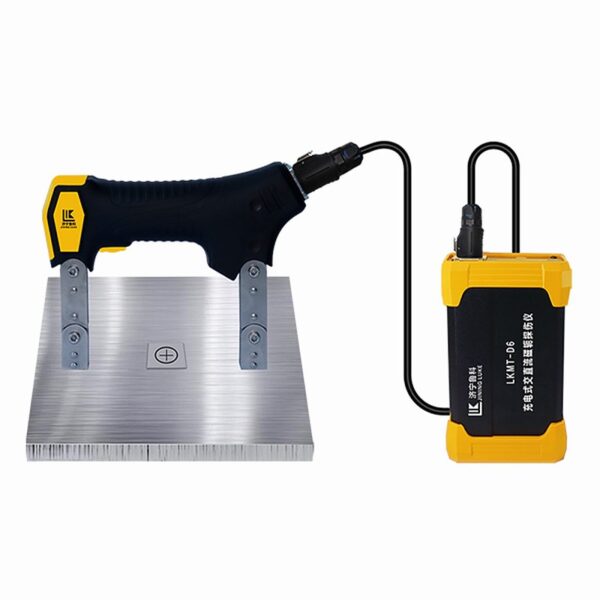
How an electromagnetic yoke works
A yoke is a hand-held U-shaped electromagnet. Placed with its poles on the part, it closes the magnetic circuit and magnetises the area between the poles. Flaws lying across the line between the poles show best, so each area is tested twice, with the yoke turned by about 90° — as described in EN ISO 9934-1 and, for welds, EN ISO 17638.
The field weakens as the poles move apart. The EN ISO 9934 series recommends a tangential field strength of the order of 2 kA/m at the test surface — the pole spacing is chosen to reach it, and successive yoke positions must overlap.
AC or AC/DC yoke
An alternating field (AC) concentrates at the surface — it is best at finding surface cracks, which makes it the standard choice for welds, and the part is easy to demagnetise afterwards. A direct field (DC) penetrates deeper and shows flaws just below the surface better, and a DC yoke has a higher lifting force. AC/DC yokes let you switch modes to suit the task.
The mains-powered Uniflux UF 230 works with an AC field. The Uniflux UF 220 runs AC from the mains and DC from a battery, while the LKMT-D3 and LKMT-D6 work in both modes on a battery — no mains cable, which helps on scaffolding, in the field and in tight spots.
Yoke comparison
| Yoke | Power | Field | Lifting force | Pole spacing | Light |
|---|---|---|---|---|---|
| Uniflux UF 230 | 230 V mains | AC | 170 N | 140 mm | — |
| Uniflux UF 220 | 220–230 V mains or battery | AC / DC | AC ≥ 69 N, DC ≥ 216 N | 0–220 mm | UV-A LED |
| LKMT-D3 | battery in the body | AC / DC | AC ≥ 78.4 N, DC ≥ 196 N | 49–139 mm | white and UV-A |
| LKMT-D6 | separate battery module | AC / DC | AC ≥ 78.4 N, DC ≥ 245 N | 60–205 mm | white and UV-A |
Lifting force check
A yoke is checked periodically by lifting a steel plate or test weight at the largest pole spacing that will be used. ASTM E709 and ASME Section V require at least 4.5 kg (approx. 44 N) for an AC yoke and 18 kg (approx. 177 N) for a DC yoke. Each product page gives the manufacturer’s lifting force for that yoke.
Detection media — black and fluorescent inks and white contrast paint — are in Magnetic particle testing consumables (MT), and UV-A lamps for the fluorescent method in UV-A LED lamps for MT and PT.
Frequently asked questions
Which yoke should I choose for weld inspection?
For most welds an alternating-field (AC) yoke is enough, because weld flaws are mostly surface cracks. With a mains socket on site — a mains yoke such as the UF 230; in the field and at height — a battery LKMT-D3 or LKMT-D6.
What lifting force is required?
Under ASTM E709 and ASME Section V an AC yoke must lift at least 4.5 kg (approx. 44 N) and a DC yoke 18 kg (approx. 177 N) — at the largest pole spacing that will be used. A specific procedure or client may require something else, so check before you buy.
Is a battery yoke as effective as a mains yoke?
Effectiveness depends on the lifting force and field strength at the pole spacing you use, not on the power source. A battery gives cable-free work; just keep it charged — the LKMT-D3 switches itself off on a low battery instead of working with too little force.
How should the yoke be placed on a weld?
Each area is tested twice, with the yoke turned by about 90°, and successive positions must overlap. The ink is applied while magnetising and the indications are assessed before the yoke is lifted.
Does the part need demagnetising after testing?
When residual magnetism would interfere with further machining, welding or the part’s service. Residual magnetism is higher after DC magnetisation; an AC yoke demagnetises the part when it is slowly drawn away while energised.